
Atlas Platform · For Companies
See your culture. Move it on purpose.
THE COST OF FLYING BLIND
Culture is not a poster in the lobby. It is the operating system underneath every decision.
When it works, you feel it: meetings end with clarity, people ship without permission, hard truths get spoken in time. When it doesn’t work, you also feel it: the same problem in three different teams, the third reorg in two years, the talent who quietly leaves before the exit interview.
The numbers are not subtle:
– 6.9× market performance over 15 years in strong-culture companies. (Stanford / Good to Great) – +756% profit growth across 200 companies, 11-year horizon. (Kotter & Heskett, Harvard) – 3× the odds of outperforming competitors when organizational health is high. (McKinsey) – Culture predicts innovation. Innovation predicts results. (Zhang et al., 2023)
So why do most leadership teams still guess?
Because culture has been the one thing nobody could measure without flattening it into a survey score. Until now.
WHY VISIBILITY CHANGES EVERYTHING
If you don’t know where you are, you can’t choose where to go next.
Every transformation we’ve ever seen fail had the same root: a leadership team trying to move a system they couldn’t see. They argued about symptoms. They ran initiatives that cancelled each other out. They picked frameworks like clothes off a rack.
A map changes the conversation. The same eight people who couldn’t agree on the problem suddenly point to the same spot and say: there. That moment is worth more than any consultant’s opinion.
But here is the part most people miss.
Visibility is step one, not the whole journey. A beautiful map that nobody acts on is decoration. The point of seeing where you are is to choose the next step that actually moves you. One small, well-aimed move beats ten ambitious initiatives that pull in different directions.
This is what we build with you: the picture, the conversation, and the next move.
THE MAP THAT HOLDS EVERY OTHER MAP
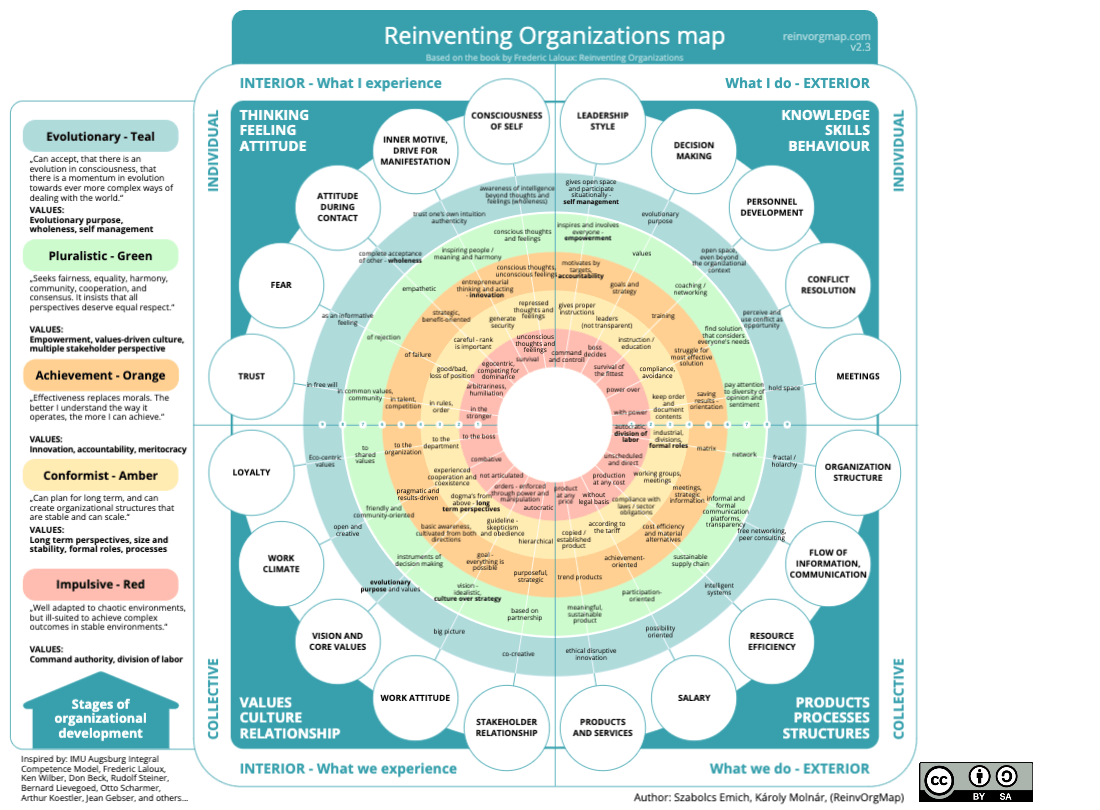
There are dozens of organizational frameworks. Spiral Dynamics. Laloux’s Reinventing Organizations. Integral four-quadrant models. Theory U. Agile maturity models. Each one shows a true piece of the elephant.
We integrated them. One map. Twenty developmental lines. Four quadrants of human reality: inner and outer, individual and collective. A nine-step scale from survival to self-organizing.
It is the only diagnostic frame we know of that holds every other framework inside it. If you already use one, we don’t ask you to throw it out. We show you where your favorite tool lives on the bigger picture, and what it can’t see on its own.
This matters for one reason: your culture is not one thing. It is a pattern across many lines at once. A team can be brilliant at decision-making and broken at conflict. World-class on strategy and stuck on feedback. One number can’t tell that story. A map can.
Side-by-side: the four-quadrant template (clean, labelled) and the same template populated with one organisation’s data. Caption: Left, the frame. Right, your reality on the frame.
THE LINEAGE WE STAND IN
We didn’t invent any of this from scratch. We integrated three giants into one working instrument, and we walk every client through the work in conversation with all three of them. These are the thinkers whose shoulders we stand on.
Bernard Lievegoed (1905-1992)
Dutch psychiatrist. Founder of NPI Holland, the institute that gave the world modern organisational development as a discipline. Gave us the developmental phases (pioneer, differentiated, integrated) we use to read your organisation’s inner shape.
Otto Scharmer
Senior lecturer at MIT. Co-founder of the Presencing Institute. Author of Theory U. Arguably the most advanced organisational development methodology in the world today. We facilitate from his lineage.
Frédéric Laloux
Author of Reinventing Organizations. The book that named the developmental colours (red, amber, orange, green, teal) the world now uses to talk about organisational consciousness. His framework forms one of the axes of our map.
These are not our advisors. They are our teachers. The difference matters. We name them because the visitor who recognises any of these three already knows what kind of work this is, and the visitor who doesn’t recognise any of them deserves to know that this is not a survey vendor with a clever brand. This is a tradition of organisational development with depth behind it, made operational with a tool for the era we are stepping into now.
SCALABILITY YOU HAVEN’T SEEN BEFORE
This is where most diagnostic processes break. Surveys scale but flatten. Interviews go deep but cost months. We refused to choose.
The Atlas approach scales in four gears, and you pick the one that fits the moment:
One leader, one map. A single 90-minute interview. We can build a first map of how that leader sees the organization. Useful as a leadership coaching mirror, useful as a sample, useful as a starting point.
Five interviews a day. A small team of mappers can run five 1.5-hour leadership interviews per day. A leadership team of fifteen people becomes a layered map in three days, not three months.
Group mapping workshops. Twelve people in a room, two hours, one shared map of how the team actually works. Faster than interviews, deeper than a survey. Great for whole departments.
AI-assisted mapping at scale. Our AI layer can process hundreds of structured conversations or open-text responses and surface the patterns onto the same map. You can run a 5,000-person organization through the same frame as a 12-person team. Same language. Same picture. Same next-step logic.
The result: you measure culture with the depth of an interview and the reach of a survey. Year over year. Quarter over quarter. Across business units and across countries.
Four small map variants in a row. Single-leader map. Five-interview leadership map. Group-mapping board. AI-aggregated enterprise map. One visual language across all four.
THREE PATHS, AS EXAMPLES
THREE PATHS, AS EXAMPLES
We don’t sell a single product. We bring a frame. The frame travels with whatever transformation you are already running: post-merger integration, culture change, leadership development, succession, scaling, regulatory pressure, purpose work. Pick yours.
To make it concrete, here are three of the most common doorways companies walk through with us. They are examples, not a menu. If your question is not on this list, that is normal. Bring it to the call.
Path 1. Agile transformation that actually sticks
Path 1
You’ve done the trainings. You have the standups, the boards, the ceremonies. Some teams fly. Others perform agility on the surface and run waterfall underneath. The map shows you exactly where the practice is real and where it’s theatre. More importantly, it shows you the developmental lines that are still pulling teams back, so the next investment lands where it can actually move the system.
Path 2. Reinventing toward Teal
Path 2
You feel the call to a more organic, self-organizing way of working. Good. Many of our clients do. But Teal is not a uniform you put on. It is a developmental achievement, and you can only get there from where you actually are. The map shows you which capacities are already there, which ones need to grow first, and which Teal practices would break your organization if you imported them next Monday. Then we walk the path with you, one honest step at a time.
Path 3. From Teal to agentic. The next horizon.
Path 3
This is the part most consultancies are not yet ready to talk about. We are. McKinsey’s Agentic Organization report (September 2025) put a number on the gap: 89% of organisations are still in the industrial era, 9% in the digital era, roughly 1% are decentralised or agentic. Their conclusion is the one most leadership teams underestimate. Culture matters more in the agentic era, not less. The human layer is the differentiator. Five pillars matter in the agentic shift: business model, operating model, governance, workforce and culture, technology and data. Four of the five are human work. Rosario Sica, writing in HBR Italia (May 2026), names what comes next: the agentic transition is the natural step after Teal. Purpose has to become specific enough that AI agents can be tasked with honoring it. Leaders shift from directing people to designing the system in which humans and AI agents work side by side. HR becomes responsible for human and agent development at the same time. Here is the hard truth nobody is selling: you cannot bolt AI agents onto an Amber organisation and expect Teal outcomes. Trust, transparency, decision rights, feedback loops, sense-making capacity. These are the cultural prerequisites of agentic work, and they have to develop before the technology lands. Atlas measures exactly this. We are extending the Reinventing Organisations Map with a complementary instrument, the Atlas Agentic Readiness Map, that makes the human side of AI readiness visible on the same frame. Same logic. Same language. New developmental lines for the era we are stepping into. > The thesis in one line: Human developmental maturity is the prerequisite for agentic capability. We measure it. Then we walk the next step with you. Three doorways, one engine. And the doorway you walk through can have any name. Whatever the headline of your transformation, the work underneath is the same: see where you are, choose the next move, measure that you moved. —
A story from the work.
A STORY FROM THE WORK. MEXICO.
In January, we facilitated a leadership retreat in Val d’Isère with thirty global leaders. The conversation kept returning to one question: how do organisations actually evolve, and how do we evolve with them?
One voice cut through. Andrés, a courageous regional director from Latin America, leaned forward and asked: what if we brought this evolutionary lens into our real-life leadership challenges?
A few months later we found ourselves in Mexico, together with Philippe, the internal OD lead, guiding a two-day intensive with seventeen bold leaders. Each one carrying real complexity. Each one expecting another corporate workshop.
What happened surprised us.
The group opened. Deeply. They saw one another. They listened. They told the truth. By the end of day two there were so many new initiatives emerging that we had to pause and group them. On day three, eleven of the seventeen leaders came back voluntarily for short coaching sessions. Eager. Inspired. More aligned than they had been in years.
One of them said it like this: “I appreciate the way I reinvent myself. The way I love. The way I bring others with me.”
That sentence is not in any framework. It is what becomes possible when a team finally sees itself on a map it can read together. The map didn’t do the work. The people did. The map gave them somewhere to stand.
This is what we mean when we say the picture, the conversation, and the next move.
In Romania, a different story, a different doorway. Sixty-nine people at NAOS, exhausted by repeated change initiatives. The Edusessment gave them a map they drew themselves. Four groups, twelve leverage points. Six months later: engagement up from fifty-two to sixty-eight percent. Turnover intention down from thirty-five to eighteen percent. Not because someone handed them a plan. Because they drew the picture and owned what it showed.
WHICH PHASE IS YOUR ORGANISATION IN?
WHICH PHASE IS YOUR ORGANISATION IN?
Bernard Lievegoed, the Dutch psychiatrist who founded modern organisational development at NPI Holland, gave us the cleanest picture of how companies actually grow. Three phases. Each one carries its own genius and its own crisis.
We use his frame because it holds something a headcount number cannot: the inner shape of the organisation, not just its size. Two companies of 200 people can be in completely different phases. Pick the one that sounds like home.
Phase 1. The Pioneer organisation
Path 1
A founder. A founding team. Direct relationships everywhere. Decisions happen in the corridor. The culture lives in one or two people’s instincts. It works beautifully. Until it stops working. The pioneer crisis is the moment when the founder cannot hold every relationship anymore, and the things that made the company magic start producing chaos. People wait for permission that never comes. Quality drifts. The same problem shows up in three departments because nobody is talking across. What we do for you in this phase: one or two deep leadership interviews, a first map of your organisation in days, a working session that names the three patterns most worth attending to in the next quarter. Light, fast, founder-grade. The goal is clarity for you, the person carrying the weight, before patterns harden into structure. > Sounds like home if you are: a founder, CEO, CTO, or founding team feeling the first growing pains. Often companies of 10 to 80 people, but the phase is the signal, not the headcount. > [GET A FOUNDER’S MIRROR →] > A 20-minute call with Szabolcs. We open the map of an organisation that looked like yours, and you see what you couldn’t see from inside.
Phase 2. The Differentiated organisation
Path 2
You introduced structure and survived the pioneer crisis. You have departments. You have processes. You have a leadership layer between the founder and the front line. The trains run on time. The differentiated crisis is the opposite of the pioneer one: the structure that saved you starts to suffocate you. Silos appear. Initiatives slow. People follow the process even when the process is wrong. Hard truths get filtered upward. The company becomes efficient at the wrong things. What we do for you in this phase: a leadership-and-team mapping process across the whole leadership layer. A written diagnostic. A facilitated workshop where the leadership team meets the picture together and names the patterns nobody was saying out loud. A concrete development plan. Optional follow-up mapping each year so you can show the board what changed and what didn’t. > Sounds like home if you are: Head of People, Head of Transformation, OD lead, COO, internal change manager. Often companies of 80 to 800 people. > [MAP YOUR LEADERSHIP LAYER →] > A 20-minute scoping call. We sketch what a full leadership mapping would look like in your organisation, what timeline is realistic, and what your first board-ready picture could contain.
Phase 3. The Integrated organisation
Path 3
You are not trying to be more efficient. You are trying to become more conscious. Your people want meaning, not just job descriptions. Your strategy keeps bumping into culture. You are running multiple transformations at once: agile, AI, sustainability, purpose. They contradict each other unless something deeper holds them together. This is the integrated phase Lievegoed pointed to: the organisation as a living system, where structure, culture, and purpose are aligned, and the human being becomes the centre of the design instead of the obstacle to the plan. Most large organisations are not here yet. The ones moving toward it need a frame strong enough to navigate. There is one structural reality every large organisation runs into here. Robin Dunbar’s number. Human beings can hold about 150 stable relationships. That is the natural ceiling of a single shared culture. Above 150 people, you don’t have one culture anymore. You have a constellation of subcultures pretending to be one. Pretending makes them invisible. Invisible makes them ungovernable. This is why we map large organisations not as one monolith but as a constellation of subcultures. Each unit, each site, each function gets its own picture on the same frame. Then we can finally talk about how they relate, where they pull against each other, and what the centre actually has to do. What we do for you in this phase: a multi-level mapping program. Interviews with key leaders, group mapping with selected teams, AI-assisted mapping across the wider population. Subculture maps for the units that matter. One shared visual language across the whole organisation. Year-on-year comparison. Cross-unit benchmarking inside your own company. A way to show executive sponsors that the work is moving, where, and how the parts are starting to integrate. Edusessment. Three things in one room. This is the format that makes the integrated phase scalable without losing depth. We bring a team into a single facilitated session where three things happen at once. Education: the team learns the developmental framework, the dimensions, what the colours actually mean. Team building: the act of looking honestly at the same picture together is one of the most bonding experiences a leadership team can have. Assessment: by the end of the session the team has produced its own map, with patterns no individual member could have seen alone. Three deliverables. One day. The same map gets fed back into the enterprise constellation. We don’t know another methodology that does this in a single move. [ See the full Edusessment program ] > Sounds like home if you are: Chief Transformation Officer, Head of OD and Culture, internal consulting lead, agile transformation lead, AI readiness lead. Often companies of 500 people and up, sometimes tens of thousands. > [DESIGN YOUR ENTERPRISE MAPPING PROGRAM →] > A 30-minute strategy call. We walk through your organisation’s structure, identify the units and subcultures that matter, and sketch a multi-level mapping program your sponsors can sign off on. —
WHY US
We’ve been asked this question for fifteen years. The honest answer in six lines:
One map, every framework. The only diagnostic frame we’ve found that holds Spiral Dynamics, Laloux’s Reinventing Organizations, the integral four quadrants, Theory U, and the agile maturity world inside it. Use what you already use. We give it a home.
We work where most consultancies will not go: the human being. Most organisational work stops at process, structure, and policy. We go further. We work with the inner development of leaders and the relational intelligence between them. We have seen it again and again: when you upgrade your systems and your people in parallel, the change holds. When you upgrade only one, it bounces back within a year. The map shows you both layers on the same picture.
Theory U at the core. Our facilitation lineage runs through MIT’s Presencing Institute and Otto Scharmer’s Theory U: arguably the most advanced organisational development methodology in the world today. It is how we hold the deeper conversations that turn a diagnostic into a transformation. Not workshops as theatre. Workshops as a place where something actually shifts.
Measurable, year over year. For the first time, the impact of organisational development becomes visible on a chart your CFO can read. Same map, same lines, two timestamps. The difference is the work.
Days, not quarters. From first interview to a boardroom-ready picture in days. We refuse the consulting tradition of selling time as proof of value.
AI-supported. Human-led. AI does the pattern work it is good at. Humans do the meaning-making it isn’t. The map is the meeting place.
A hub, not a single consultancy. Atlas is building something larger than one firm. We are creating a platform where the best developmental tools and the best certified practitioners come together, across languages, across geographies. When you work with Atlas, you are not hiring one consultant. You are accessing a curated network of practitioners who all work with the same map, the same method, and the same commitment to doing this work with depth. If your organization needs a practitioner in German, in Spanish, in Romanian, in French, the network has one. If your challenge requires two practitioners working across three time zones, the network can hold it.
A WORD ABOUT THE PEOPLE BEHIND THIS
Atlas Platform is led by Szabolcs Emich, organizational developer, agile innovator, creator of the Reinventing Organizations Map. Sixteen years of agility and transformation work. Fourteen years as a CTO inside agile organizations. Founder of an organizational development innovation hub.
Around him, a stewarding team of practitioners with twenty-plus years each in self-organizing systems, integral coaching, organizational design, and agile transformation. Past clients include E.ON, Deutsche Telekom, Porsche Hungaria, MOL, Continental, DM, Audi, Groupama, KPMG, NN, and a long list of scale-ups across Europe.
We are not a big-four consultancy. We don’t pretend to be. We are practitioners who built the tool we always wished we had, and we use it with the clients we choose to work with.
A story from the work.
WHAT HAPPENS WHEN YOU BOOK A CALL
Twenty minutes. No deck. No pitch.
We ask three questions: where is your organization right now, what is the move you’re trying to make, what would change if you actually saw the picture. If there is a fit, we’ll show you a real map from a real organization on the call, and we’ll sketch what your first step with us could look like. If there isn’t a fit, you’ll leave with two or three useful pointers and our blessing.
That is the promise. Twenty minutes you won’t regret.
WHEN ATLAS IS NOT THE RIGHT FIT
We would rather save you twenty minutes than sell you something that does not fit.
Atlas is not the right choice if you are looking for a quick employee satisfaction survey with a single score. We are not a survey vendor. If what you need is a pulse check and a benchmark number, there are good tools for that and we will happily point you to one.
Atlas is not the right choice if the leadership team is not willing to look at itself. The map shows the whole picture. That includes leadership. If the mandate is “assess the teams but don’t touch the top,” the diagnostic will be honest and the findings will be uncomfortable. We do this work with leaders who want to see, not leaders who want to confirm.
Atlas is not the right choice if you need a report delivered in two weeks with no facilitated conversation. The map is not a document. It is a shared picture that lives in the room. If nobody in the room engages with it, it becomes decoration. We do not do decoration.
If any of these sound like your situation, that is not a judgment. It is a signal that a different tool fits better right now. The twenty-minute conversation will clarify this in the first five minutes.
FAQ (SHORT, HONEST)
How long does a first mapping take? For a leadership team of seven: roughly two weeks from kickoff to the workshop. Faster if you need it faster.
Do you replace our existing OD work or sit on top of it? Sit on top. The map gives your existing work a shared frame. We rarely ask anyone to stop doing something that’s already serving them.
Is this a survey? No. A survey produces a number. We produce a picture, a story, and a move.
Do you work in English? Yes. The platform is available in 19 languages. Most of our enterprise work runs in English.
Can we run this internally after the first project? Yes. We train internal teams to use the platform. Many of our enterprise clients run their second mapping cycle themselves with us as backstop. We also offer a certification program for consultants and internal OD practitioners who want to master the full Atlas Method independently. [ See the certification program ]
How do we find the right consultant for our organization? You do not have to. Atlas is a hub where certified practitioners work across languages and regions. When you book the twenty-minute conversation, we match your organization with the practitioner whose language, location, and expertise fit your context. If Szabolcs is the right fit, he runs it. If a certified local practitioner is better, we make the introduction. One conversation, and you are connected with the right person.
What size organization is this for? We’ve used the same frame with twelve-person founding teams and with multi-thousand-person enterprises. The shape of the engagement changes. The map doesn’t.
One last thing.
Your culture is already speaking. Loudly. To customers, to candidates, to your own people. The only question is whether you can hear it clearly enough to lead it on purpose.
We help you hear it. Then we help you move.
Draft notes for Szabolcs:
– No prices anywhere, per spec. – Three phases (Lievegoed) live inside one page, each with its own reader voice and its own CTA. We can split into three URLs later if Ads performance asks for it. – Strengths emphasised: Lievegoed phases as the inner-shape frame, integrative map (one frame for every framework), Theory U / MIT lineage, the human and relational layer that other consultancies skip, scalability across four gears, edusessment as the 3-in-1 format, Dunbar and subculture mapping for large organisations, Agentic Renewal as the next horizon, year-over-year measurability, AI + human, days not quarters. – Em-dashes: zero. Buzzwords: zero. Bullet density kept low; most weight in prose. – Hero, the agentic horizon section, and the three phases are the places to test with paid traffic first. – Open question: do we want one named case study (Mortoff, Telekom, NAOS) inline, or a dedicated “stories” page linked from here? – v4 changes (BetterUp comparison integration): tighter hero with two-line opener above the manifesto rhythm, video placeholder for the map-build loop, trust-strip logo wall directly under hero, new Lineage section with three portraits (Lievegoed, Scharmer, Laloux) acknowledging our tradition without claiming endorsement. – Outstanding asks before build: (1) commission the 30-45s map-build video, (2) source the four portraits for the Lineage section (Wikimedia public domain or licensed), (3) open the named-case-study conversation with Andrés or Philippe from Mexico, target a quote and a portrait by end of month, (4) make sure the developer builds the four research stats as 2×2 stat cards, big numbers, small sources. Don’t let it collapse to bullets.