
Atlas Platform · The Edusessment
The Edusessment.
Education. Assessment. Team-building. One program.
TRUST NUMBERS STRIP
Facilitated across [X] organizations in [Y] countries. Available in nineteen languages. From fifteen-person leadership teams to two-hundred-person departments.
WHAT IS THE EDUSESSMENT
The Edusessment is the Atlas Method’s signature engagement. It combines three things that are usually sold separately: learning, measurement, and team development.
Your team learns how organizations develop through stages. Then they map their own culture using what they just learned. Then they identify the two or three places where energy invested would create the most movement. All of this happens in the room. Together. In two days.
This is not a workshop where someone talks at your team. This is not a survey that disappears into a spreadsheet. This is a live, facilitated process where the team creates the output. When a team draws its own map, it cannot unsee what it drew.
The word itself says it: education plus assessment. The learning is the assessment. The assessment is the learning. And the whole thing builds the team while it happens.
THE TWO DAYS
THE TWO DAYS
Day 1. Frameworks and visual mapping.
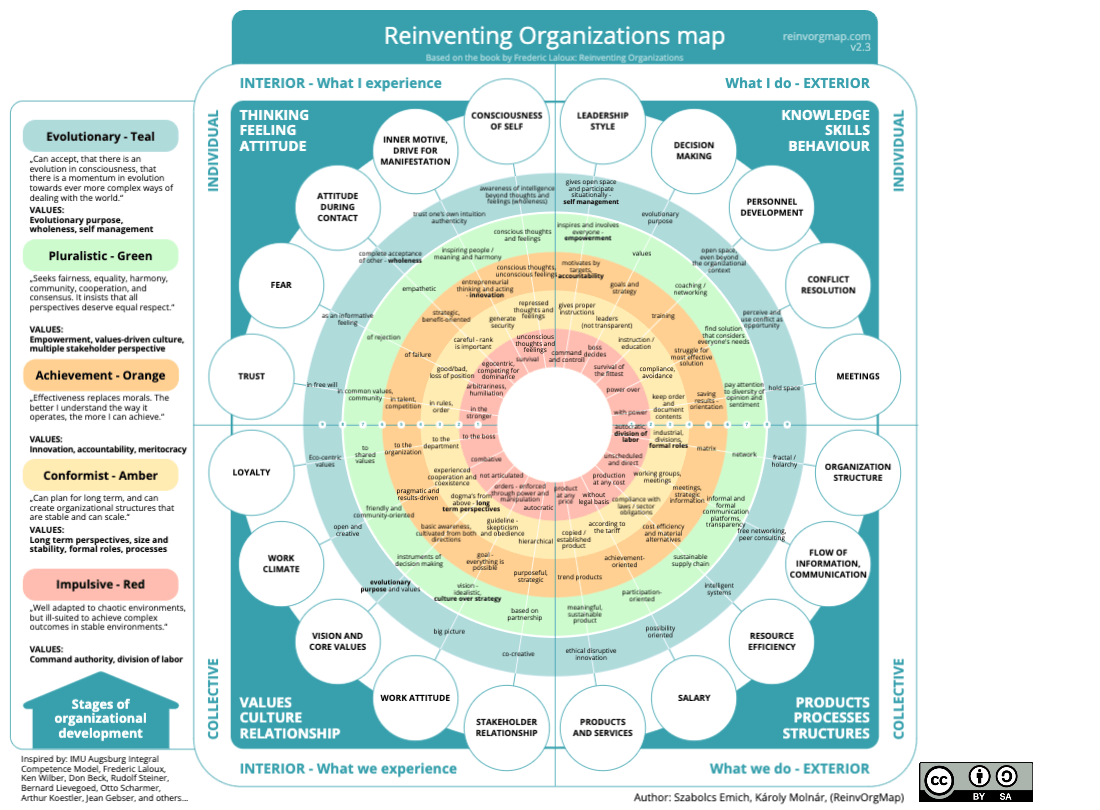
Your team learns the developmental language. How organizations grow through stages. What each stage looks like. What it protects. What it makes possible. The colors become a shared vocabulary: red, amber, orange, green, teal. Not as labels. As a way of seeing. Then they draw. Four or five groups. Each group maps the organization’s culture as they experience it. On paper, with markers, using the Reinventing Organizations Map as the frame. The conversations that start during the drawing are already the beginning of the shift. By the end of the first day, there are four or five maps in the room. And the conversation has already started.
Day 2. Pattern recognition, leverage points, roadmap.
The maps are on the wall. Now the team reads them together. What patterns do the groups share? Where do they disagree? What is the organization defending? What is trying to emerge? The facilitator guides the team toward two or three concrete leverage points per group: the places where a developmental step would create the most movement. Not fifty recommendations. Two or three. The ones that fit. By the end of the second day, the team owns a development roadmap they built themselves. Not a consultant’s recommendation. Their own picture. Their own priorities. Their own next steps. —
WHY IT WORKS
WHY IT WORKS
The team creates the output.
Most assessments produce a report that a consultant delivers and a leadership team receives. The Edusessment reverses this. The team draws the map. The team identifies the patterns. The team chooses the leverage points. What the team creates, the team owns. And what the team owns, the team acts on.
The maps become shared artifacts.
The maps do not disappear after the workshop. They go on the wall. They get referenced in meetings three months later. They become the common language the organization uses to talk about its own culture. One visual frame that holds the complexity without flattening it.
The process itself creates change.
This is the principle that surprises people the most. In the Edusessment, the diagnostic is already the intervention. Every conversation during the mapping plants seeds. Every pattern the team recognizes together opens a door. The act of making culture visible already begins to shift it. You do not need to wait for the report to start changing. By the time the second day ends, the change has already begun.
Stage-appropriate, not aspirational.
The Edusessment does not prescribe an ideal. It does not benchmark against best practice. It reads where the organization actually is and identifies the next step that fits. If the organization is at Orange and the leadership team is dreaming about Teal, the Edusessment names the real next step, not the aspirational one. This is what makes the roadmap actionable. It fits. —
WHAT IT FEELS LIKE TO FACILITATE
Most workshop designs are dense. Overloaded with theory, overstuffed with slides, dependent on the facilitator’s charisma to hold the room. The Edusessment is the opposite. It breathes.
There is a ready-made arc that is easy to follow and easy to love. It starts from connection: exercises that warm the atmosphere, open people up, make the room safe enough for honesty. Then the rhythm begins. Playful, light, relational moments alternate with moments of awareness, of waking up. The easy and the challenging take turns. Underneath, the whole process follows the U movement from Theory U: downloading, seeing, sensing, presencing, crystallizing, prototyping. The arc gives everything a shape that feels both natural and meaningful.
The tools are well chosen and come from the best sources. Theory U from MIT. Agile retrospectives. Team manifesto and consent agreements from Sociocracy 3.0. The seven levels of delegation from Management 3.0. Pro-action café from the Art of Hosting. 1-2-4-all from Liberating Structures. Dynamic judgement formation for decision-making. Every element is replaceable with your own tools if you already have ones you trust. Even the mapping itself can use a customized map instead of the standard one.
Technology is not pushed. Theory is not overloaded. What arrives quickly in the room is the “make sense” moment: participants feel something click. They feel grateful for the new frameworks, the new examples, the new way of seeing their own organization. That gratitude is the signal that the process is working.
If you are a facilitator reading this: the Edusessment is designed so that you can hold the space without performing. The room does the work. You hold the rhythm.
SMALLER VERSIONS
SMALLER VERSIONS
Two days is the full format. When two days are not possible, there are two alternatives.
One-day Edusessment.
Frameworks in the morning. Mapping and leverage points in the afternoon. The same principles, tighter scope. Best for leadership teams of ten to fifteen people who need a concentrated diagnostic experience and can move fast.
Half-day Edusessment.
A focused session for senior leadership teams of five to ten people. Compressed framework introduction, one round of mapping, and a facilitated conversation about the two or three most visible patterns. The co-created roadmap and the deeper leverage point analysis are what this version trades for speed. Best as an entry point: the leadership team gets a first taste, and if the picture calls for it, the full Edusessment with the wider team follows. The principles are the same in every format. The depth adjusts to the time available. —
TWO STORIES FROM THE WORK
TWO STORIES FROM THE WORK
Romania: sixty-nine people, four maps, twelve leverage points.
NAOS Romania. A cosmetics company in the middle of an intense transformation. Sixty-nine people. Ninety percent women. A team exhausted by repeated change initiatives and recurring conflict cycles. The Edusessment gave them something no previous initiative had: a map they drew themselves. Four groups. Four maps. Twelve concrete leverage points. The change fatigue did not disappear, but it was replaced by something stronger: ownership. The team owned the picture. The team owned the next steps. What happened after: the visual maps became the language the team used to talk about culture in meetings months later. Internal communication improved because the maps were easy to share. The recurring “storming” cycle finally had a name and a frame. The team could see it, and seeing it, they could work with it instead of being trapped inside it.
Mexico: from control to trust in eighteen months.
A leadership team stuck between control-based management and a developmental aspiration they could feel but could not name. The Edusessment gave them the shared picture. The sensemaking session that followed revealed the gap between where the leaders were and where the teams were. Eighteen months of coaching, bite-size trainings, and two annual re-assessments later: the leadership team had moved from managing through control to facilitating through trust. The map showed the shift. The team confirmed it. The Edusessment was the starting point. The developmental journey was the path. The annual re-assessment was the mirror that showed the team how far it had come. —
WHAT COMES BEFORE, WHAT COMES AFTER
WHAT COMES BEFORE, WHAT COMES AFTER
The Edusessment does not happen in isolation. It sits inside a larger arc.
Before: the conversation.
It starts with twenty minutes. A conversation with Szabolcs about what you see in your organization and what you cannot see. By the end of the call, we both know whether the Edusessment is the right entry point. Sometimes it is. Sometimes a leadership diagnostic comes first. Sometimes the answer is: come to a free webinar and return when you are ready.
After: sensemaking and the developmental journey.
The Edusessment produces the map. The sensemaking session reads it together with the leadership team: what are the patterns, what are the tensions, where is the real next step. From there, the developmental journey begins. Leadership coaching. Bite-size trainings. Conflict resolution. Decision-making development. System redesign. Whatever fits the stage. And once a year, the Edusessment returns. The team draws the map again. New patterns emerge. The team sees how far it has come. This is where the cycle closes and opens again. As the Map evolves with new developmental lines, including the emerging Agentic Readiness dimensions, the annual re-assessment also captures how the organization is growing into the era of human and AI collaboration. [ See the full client journey: How We Work ] —
FOR CONSULTANTS: LEARN TO RUN THE EDUSESSMENT
If you are a consultant, coach, or internal OD practitioner, the Edusessment is the engagement you will run most often. The one that opens doors, closes deals, and changes teams in two days.
The Atlas Method certification teaches you the complete Edusessment practice: how to prepare, how to facilitate Day 1 and Day 2, how to hold the space while the room does the work, and how to guide the team from map to leverage points to roadmap. Module 1 gives you the diagnostic foundation. Module 2 takes you through the full Edusessment arc with a real pro bono project.
You do not lecture. You hold the space. The room does the work.
When you are certified, you join a network where organizations looking for exactly this kind of help find you. Atlas is building a hub where developmental needs and the best practitioners meet across languages, geographies, and industries. Your certification is not the end of your training. It is the beginning of a practice inside a living community: ongoing learning, shared cases, referral circulation, and the continuous evolution of the method and the tools.
NUMBERS
Fifteen to thirty people is the sweet spot for the full two-day Edusessment. Four or five mapping groups. One facilitator. Two days.
For smaller teams (five to fifteen people), the one-day or half-day versions work. For larger organizations (fifty to two hundred people), we run multiple Edusessment rounds across departments and synthesize the maps in a leadership sensemaking session.
The Edusessment can be facilitated in English, Hungarian, German, French, and Spanish. The Reinventing Organizations Map is available in nineteen languages. For other languages, we work with certified local practitioners.
Frequently asked questions
FAQ
What does it cost?
The Edusessment has a clear scope and a clear investment. The two-day format is a four-figure investment that varies with the location (on-site or online), travel requirements, and organizational context. We do not publish a fixed price because these factors shape the design. The twenty-minute conversation is the place to get a transparent picture.
Can we do it online?
Yes. The two-day Edusessment can be run online using collaborative mapping tools. The in-person format is richer (the physical maps on the wall have a power that screens cannot fully replicate), but the online version works and has been tested with international teams across time zones.
Do we need to prepare anything?
We handle the preparation. Before the Edusessment, we conduct four to five focus group interviews with a cross-section of the team. These conversations help us understand the organizational context, build trust with the team, and customize the mapping framework. Your team arrives on Day 1 ready to learn and map.
What if we have already done culture surveys?
Good. The Edusessment is not a survey. It is a different kind of seeing. Surveys give you data points. The Edusessment gives you a shared picture the team drew together. The two complement each other. If you have survey data, it can inform the preparation. But the Edusessment works on its own.
What happens to the maps after the workshop?
The maps belong to you. High-resolution digital versions are created from the workshop outputs. Many organizations print them and put them on the wall. They become shared artifacts that the team references for months. During the annual re-assessment, the old maps and the new maps sit side by side. That is where the developmental journey becomes visible.
Can our internal people learn to run this?
Yes. That is exactly what the Atlas Method certification is for. We train consultants and internal OD practitioners to facilitate the Edusessment independently. Many organizations start with an Atlas-led Edusessment and then certify one or two internal people to run it going forward. [ See the certification program ]
One last thing.
The Edusessment is the simplest way to make culture visible. Two days. One room. A team that finally sees itself.
The first step is a conversation. Not a pitch. Not a proposal. Twenty minutes about what you see in your organization and what you cannot yet see.
Not ready to talk yet? Watch a free webinar first.