
Atlas Platform · The Atlas Method
The Atlas Method.
This is what you learn. This is what you do.
THE SIX PRINCIPLES
THE SIX PRINCIPLES
Everything in the Atlas Method follows from six commitments. These are not values on a wall. They are operational principles that change how you work with every client, in every session.
1. Developmental, not evaluative.
Most assessments ask: how good are you? How do you compare to the benchmark? The Atlas Method asks: where are you in your developmental journey? What is trying to emerge? An evaluative assessment produces a grade. A developmental assessment produces a mirror. When you learn the Atlas Method, you learn to hold the mirror.
2. Interviews, not surveys.
A survey shows you what people say when they have to tick boxes. An interview reveals what they actually live. The Atlas Method uses diagnostic interviews as the primary data source. Every person interviewed has already started thinking differently by the end of the conversation. You will learn to conduct interviews where the interview itself is the first intervention.
3. Visual, not verbose.
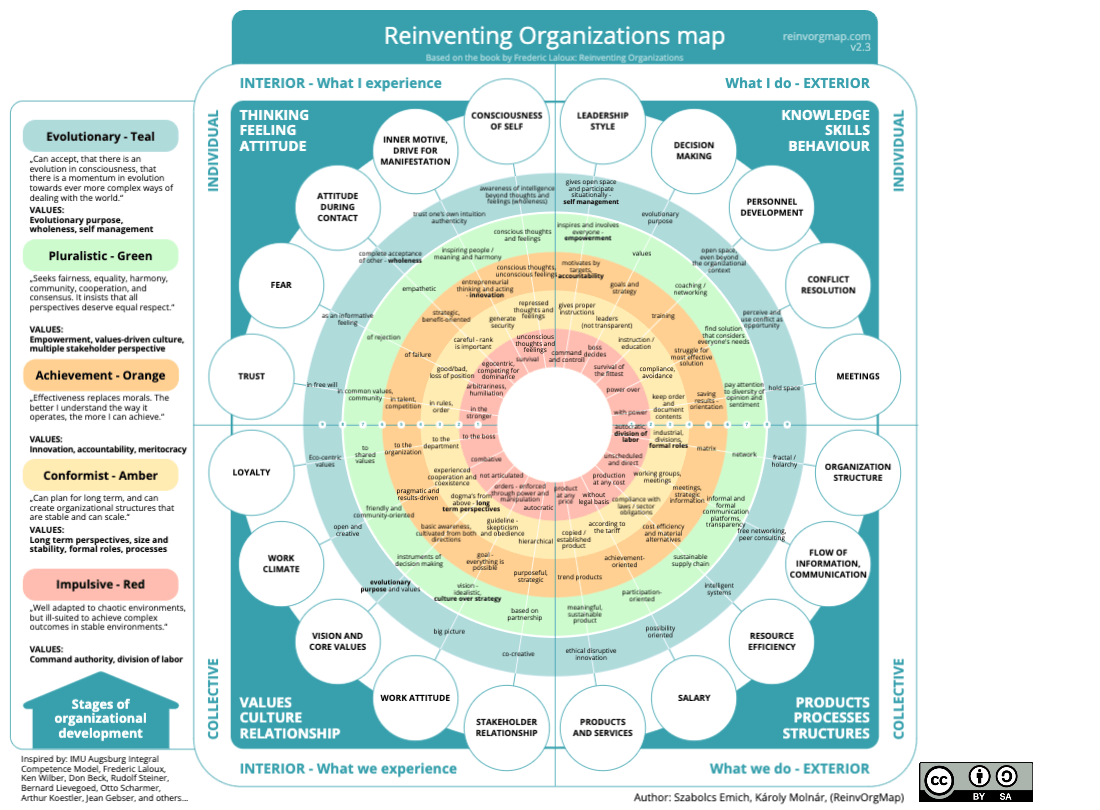
One map that shows the whole picture. Not a fifty-page report gathering dust in a drawer. The Reinventing Organizations Map is a single visual frame that holds the complexity without flattening it. Clients read it in minutes. They refer back to it for months. You will learn to build this map, to read it, and to facilitate conversations around it.
4. Systemic, not siloed.
Twenty developmental dimensions, held together as a living system. Culture connects to structure. Decision-making connects to innovation. Leadership connects to trust. The Atlas Method does not assess parts. It renders the whole. You will learn to see the system, not just the symptoms.
5. The process itself creates change.
This is the principle that surprises people the most. In the Atlas Method, the diagnostic process is already the intervention. Every interview plants seeds. Every feedback session opens doors. The act of making culture visible already begins to shift it. You will learn to trust this principle and to design your engagements around it.
6. Stage-appropriate.
We do not copy best practices. We do not benchmark against an ideal. The Atlas Method matches the intervention to the stage, not the other way around. A developmental step that is perfect for a Green organization is disorienting for an Orange one. You will learn to read the stage and to design what fits. —
THE ARC YOU PRACTICE
THE ARC YOU PRACTICE
The Atlas Method unfolds in a rhythm that repeats at every scale, with every client. This is the arc you will learn to hold.
Observe and co-sense.
The first movement is always to see. You enter the organization and you listen. Diagnostic interviews. Focus group conversations. The Edusessment workshop where the team maps its own culture together. By the end of this phase, the organization has a shared picture: the Reinventing Organizations Map, drawn from the inside, by the people who live there.
Read it together.
A map that only the consultant can read is a deliverable, not a diagnostic. In the Atlas Method, the reading happens together. You facilitate a sensemaking session where the leadership team or the transformation sponsors walk through the map, recognize themselves in it, and begin to identify the two or three leverage points where energy invested would create the most developmental movement.
Move from it.
The map becomes the starting point for developmental work. Not fifty recommendations. Two or three stage-appropriate next steps that fit where the organization actually is. The Atlas Method holds that the organization must do the work that only it can do. You hold the mirror. The organization walks the path.
Sustain it.
A one-time breakthrough is not transformation. You learn to design developmental structures that keep evolving after you leave the room. Annual re-assessments. Internal capability transfer. Governance redesign. The long arc.
Re-assess.
Once a year, the map is drawn again. New patterns emerge. New leverage points. The Edusessment returns and the team sees how far it has come. This is where the cycle closes and opens again. —
THE EDUSESSMENT: YOUR SIGNATURE ENGAGEMENT
Of everything in the Atlas Method, the Edusessment is the centerpiece. It is the engagement you will run most often. The one that opens doors, closes deals, and changes teams in two days.
The Edusessment is education, assessment, and team-building in one single program. Two days. Fifteen to thirty people. One facilitator. The team learns the developmental frameworks, maps its own culture, identifies leverage points, and co-creates a development roadmap. By the end of the second day, the team owns the map and owns the next steps.
This is not a workshop where you lecture. This is a workshop where the room does the work, and you hold the space. The Edusessment is the Atlas Method’s answer to the consultant’s oldest problem: how do you make the client own the output?
When two days are not possible, you can run a one-day or half-day version with a tighter scope. The principles stay the same. The depth adjusts.
BEYOND THE MAP: THE DEVELOPMENTAL TOOLKIT
The Edusessment and the sensemaking session give the organization its starting point. What comes next is the developmental journey. As an Atlas Method practitioner, you will learn to design and facilitate the interventions that fit the stage. In most engagements, sensemaking facilitation and leadership coaching form the backbone. The others are called in as the map reveals what the organization needs:
Sensemaking facilitation. Holding the space where the leadership team reads the map together and identifies what to move first.
Leadership coaching. Ongoing developmental coaching for leaders who are learning to lead differently. Connected to the Map, grounded in the developmental stage, not abstract.
Bite-size trainings. Short, focused learning sessions for teams: feedback in self-organizing teams, holding conflict without escalating, decision-making when nobody is in charge. These are built on what the Edusessment revealed, not on a generic curriculum.
Conflict resolution. Developmental conflict work: understanding what the conflict is about at the paradigm level and finding the resolution that fits the stage.
Decision-making development. From command-and-control to consent-based to advice process to integrative decision-making. Each stage has its own decision-making logic.
Self-organization and self-governance design. The long arc: from hierarchy to distributed authority, from roles-as-boxes to roles-as-functions. This is where most organizations want to arrive. The Atlas Method takes them there one stage at a time.
Internal training academy design. For organizations that want to build internal developmental capability over time.
Board meeting facilitation. A temporary mirror that helps the leadership team learn to hold developmental conversations on its own.
Modules 3 and 4 of the certification teach you the principles and the practices behind all of these. Module 1 and 2 give you the diagnostic foundation. The full certification gives you the complete arc.
YOUR METHOD, MADE VISIBLE
You may already have your own model. A framework you built over years of work. A diagnostic you tested across dozens of engagements. A way of seeing organizations that is distinctly yours, and that no certification will ever replace.
Atlas is not here to replace it.
The Atlas platform is more than the Reinventing Organizations Map. Underneath the Map is a mapping engine. Whatever model you bring, Atlas can host it as a visual diagnostic your clients can read in the room. Your stages, your dimensions, your language, your color system. The same tool that makes the Laloux and Scharmer integration visible in a client session can make your own method visible in exactly the same way.
Here is a live example. When McKinsey published its Agentic Organization report and Rosario Sica wrote in HBR Italia about the developmental prerequisites for AI-augmented work, we were asked to build a diagnostic map for this new territory. The result is the Atlas Agentic Readiness Map: sixteen developmental lines across four quadrants (self, collaboration, community, ecosystem), each with five maturity levels from Red to Teal. It uses the same visual grammar, the same facilitation logic, the same platform. A completely new instrument, built on the same engine.
This is what “your method, made visible” looks like in practice. You bring the model. We build the map. Your clients see themselves inside your framework, not inside a slideshow about your framework.
Your method does not become Atlas. Atlas becomes the vehicle that makes your method visible.
WHAT THE METHOD INTEGRATES
The Atlas Method stands on the shoulders of three foundational lineages.
Frederic Laloux and Reinventing Organizations. The color language that let executive teams talk about culture without flinching. Red, amber, orange, green, teal. Laloux made developmental stages visible in corporate rooms. The Atlas Method uses this language as its primary vertical axis.
Otto Scharmer and Theory U. The fields of attention from which people and systems act. Theory U gave practitioners the language for presencing, for moving from downloading to seeing to letting come. The Atlas Method uses Theory U as its listening posture: every diagnostic interview is a Theory U interview.
Spiral Dynamics (Beck and Cowan). The evolution of value systems through increasingly complex stages. The Atlas Method integrates these stages into its visual grammar without requiring clients to study the full system.
Bernard Lievegoed and the developmental phases of organizations. The Dutch psychiatrist who founded NPI Holland gave organizational development its deepest root: the insight that an organization grows through phases the way a person grows through life stages. Pioneer, differentiated, integrated. Each phase carries its own genius and its own crisis. The Atlas Method uses Lievegoed’s phases to read the inner shape of an organization, not just its size or structure.
Underneath all of them: systems thinking, self-management practice from Holacracy to Sociocracy, and the agile movement’s deep rethink of how work organizes itself.
The Atlas Method does not compete with any of these. If you already use one or more of these lineages, the Atlas Method does not ask you to replace them. It gives you the tool that makes them visible, and the practice that makes them land.
The Map itself is a living instrument. New developmental lines are being added as the world shifts. The Atlas Agentic Readiness Map, currently in development, extends the framework into the era where humans and AI agents work side by side. The lineage grows. The tool evolves. The practitioners grow with it.
A LIVING ECOSYSTEM, NOT A STATIC TOOL
We built Atlas to be more than a method and more than a platform. Atlas is a hub: a gathering place for the tools, the practitioners, and the research that take human development in organizations seriously.
Every Edusessment run, every map drawn, every diagnostic interview conducted adds to a growing body of data about how organizations actually develop. Over time, this data becomes researchable. Patterns across industries, across cultures, across developmental stages. Which interventions move which dimensions. What the transition from Orange to Green actually looks like across hundreds of organizations, not just the handful any single consultant can see. Atlas is building the research infrastructure that makes developmental organizational work a field with evidence, not just a field with theory.
For practitioners, this means continuous growth. Not just the certification, but an evolving toolkit, an evolving community, and an evolving evidence base. The method gets sharper every year because the practitioners who use it feed back what they learn.
For organizations, this means that the help you receive is grounded in something larger than one consultant’s experience. It is grounded in the collective learning of a network of practitioners across languages, geographies, and industries, all working with the same map and the same developmental commitment.
This is what a hub does. It connects the people who need developmental help with the practitioners best equipped to give it. It gives both sides a shared language and a shared frame. And it catalyzes something that neither side could create alone: a body of knowledge about how workplaces, and the human beings inside them, actually grow.
THE CERTIFICATION PATH
The Atlas Method is taught through a four-module certification program.
Module 1. See it. Master the platform, the mapping engine, and the diagnostic interview. Learn to build visual cultural maps and to conduct interviews where the interview itself is already an intervention. Finish with a real pro bono project. Two weeks, e-learning with trainer-led cohort.
Module 2. Read it. Learn to read the map as a developmental portrait. Practice with real client maps. Translate what the map shows into concrete development goals the client recognizes as theirs.
Module 3. Move it. Go beyond diagnosis. Learn to hold the space for an autonomous developmental process. The traps, the stuck places, the moments when people want to go back.
Module 4. Sustain it. Make autonomous development the organization’s default mode. Stage-appropriate design for the long arc.
Four modules, one integrated method, one practitioner credential.
THE ATLAS METHOD IN SIX SENTENCES
It is developmental, not evaluative. It listens through interviews, not surveys. It shows, not tells. It holds the system, not the parts. It changes people while it measures them. And it never prescribes what does not fit the stage.