
Atlas Platform · How We Work
This is what working with Atlas looks like.
STEP 1. THE CONVERSATION
It starts with twenty minutes.
You talk. We listen. You tell us what you see in your organization and what you cannot see. What is stuck. What has been tried. What keeps resetting.
We do not pitch. We do not sell modules. We ask questions. By the end of the conversation, we both know whether this is the right path, and if it is, which form of entry makes sense for your organization.
Sometimes the answer is: start with a free webinar and come back when you are ready. Sometimes it is: your leadership team needs a diagnostic conversation before we go wider. Sometimes it is: your sixty people need to see themselves in a room, together, in two days.
The conversation is free. It costs twenty minutes. It is the only thing we ask before anything begins.
STEP 2. SEE (THE EDUSESSMENT)
STEP 2. SEE (THE EDUSESSMENT)
The first real step is always to see. You cannot move what you cannot see. And most organizations cannot see their own culture.
This is where the Edusessment comes in.
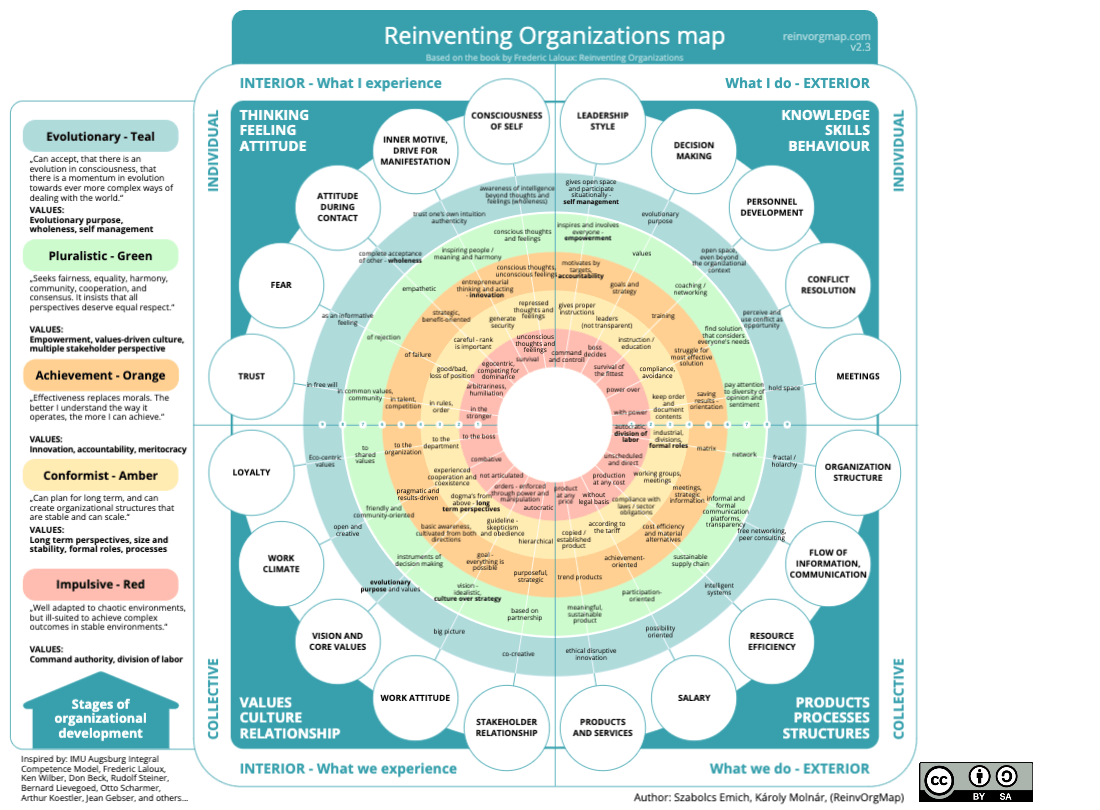
Two days. Your team. A facilitator. And the Reinventing Organizations Map drawn live, together, by the people who actually live inside the organization.
The Edusessment is not a workshop where someone talks at your team for two days. It is not a survey that disappears into a spreadsheet. It is education, team-building, and assessment in one single program.
Day 1. Frameworks and visual mapping.
Your team learns the developmental language: how organizations grow through stages, what each stage looks like, what it protects, and what it makes possible. Then they draw the map. Together. On paper. In groups. Each group maps the culture as they experience it. By the end of the first day, there are four or five maps in the room, and the conversation has already started.
Day 2. Pattern recognition, leverage points, roadmap.
The maps are on the wall. Now the team reads them together. What patterns do the groups share? Where do they disagree? What is the organization defending? What is trying to emerge? The facilitator guides the team toward two or three concrete leverage points per group: the places where energy invested would create the most developmental movement. By the end of the second day, the team owns a development roadmap that they built themselves.
What makes this different from every other workshop your team has attended.
The Edusessment works because the team creates the output. They are not receiving a report. They are drawing the map. And when a team draws its own map, it cannot unsee what it drew. The maps become shared artifacts. They go on the wall. They get referenced in meetings three months later. They become the common language the organization uses to talk about its own culture. This is what we mean when we say: the process itself creates change.
Smaller versions when two days are not possible.
Not every organization can commit to two full days. We run a one-day version with a tighter scope: frameworks in the morning, mapping and leverage points in the afternoon. And a half-day version for leadership teams who need a concentrated diagnostic experience. The principles are the same. The depth adjusts to the time available. [ Learn more about the Edusessment program ] —
STEP 3. SENSEMAKING
The map is drawn. The team has seen itself. Now we read it together.
This is a separate facilitated session, usually with the leadership team or the transformation sponsors. We walk through the patterns that emerged during the Edusessment. What is the organization defending? Where are the developmental tensions? What stage is the leadership at, and what stage are the teams at, and where is the gap?
The sensemaking session is where the data becomes direction. Not a list of fifty recommendations. Two or three developmental priorities that fit where the organization actually is right now.
This is also the session where something deeper happens. The facilitator does not present findings. The facilitator holds the space where the leadership team reads the map together and discovers what the patterns mean. This is a different kind of conversation than most leadership meetings. It is slower. It is more honest. Things get named that have been circling the room for months but never landed. When a team names a pattern together, the pattern loses its grip. That is when the real next step becomes visible.
This is where we apply the Atlas Method’s core principle: stage-appropriate intervention. We do not prescribe what does not fit the stage. If the organization is at Orange and the leadership team is dreaming about Teal, we do not pretend the jump is simple. We name the real next step, not the aspirational one.
STEP 4. THE DEVELOPMENTAL JOURNEY
Based on what the map reveals and the sensemaking clarifies, we design the path forward. Not a fixed program. A living structure that adjusts as the organization moves.
The developmental journey can include any combination of the following, depending on what the organization needs:
Leadership coaching. Ongoing, usually monthly, with the leadership team or individual leaders. This is the backbone of most long-term engagements. Leaders need a mirror that is not inside the organization. The Atlas Method provides that mirror through the Map and through developmental coaching that connects what the leader sees to what the organization needs.
Board meeting facilitation. For leadership teams that need a new way to hold their most important conversations. Not a permanent facilitator. A temporary mirror that helps the team learn to hold developmental conversations on its own.
Bite-size trainings for teams. Short, focused learning sessions on specific developmental topics: how to give feedback in a self-organizing team, how to hold conflict without escalating, how to make decisions when nobody is in charge. These are not theoretical. They are built on what the Edusessment revealed.
Methodology introduction. When an organization decides to adopt a new way of working (self-organization, sociocracy, agile at the cultural level, not just the process level), the Atlas team introduces the methodology and coaches the first implementation cycles.
System redesign. Compensation systems, performance reviews, meeting structures, information flows, governance models. When the culture is ready to move, the systems need to move with it. We design the structural changes that support the developmental shift.
Conflict resolution. Not mediation in the traditional sense. Developmental conflict work: helping teams understand what the conflict is actually about at the paradigm level, and finding the resolution that fits the developmental stage.
Internal training academy. For organizations that want to build internal capability. We help design and launch an internal learning structure that teaches the organization to do its own developmental work over time.
Decision-making development. From command-and-control to consent-based to advice process to integrative decision-making. Each stage has its own decision-making logic. We help the organization find the one that fits and practice it until it becomes natural.
Self-organization and self-governance. The long arc. Moving from hierarchy to distributed authority, from roles-as-boxes to roles-as-functions, from management-as-control to management-as-service. This is where most organizations want to arrive. The Atlas Method takes them there one stage at a time.
Not all of these. Never all of these at once. The ones that fit where the organization actually is. The Edusessment and the sensemaking session tell us which ones.
STEP 5. ANNUAL RE-ASSESSMENT
Once a year, we map again.
The Edusessment returns. The team draws the map again. And this time, they see something different: they see how far they have come. New patterns. New tensions. New leverage points. The things that were stuck a year ago may have moved. The things that were invisible a year ago may now be the central challenge.
The annual re-assessment is not a compliance exercise. It is a developmental ritual. It tells the organization: you are still growing. Here is where you are now. Here is what is next.
For many organizations, the annual Edusessment becomes the most valued event of the year. The day when the team stops and looks at itself honestly, together, with a shared language and a shared map.
TWO STORIES FROM THE WORK
TWO STORIES FROM THE WORK
Mexico: leadership evolution across eighteen months.
A leadership team in Mexico, stuck between control-based management and a developmental aspiration they could feel but could not name. The Edusessment gave them the shared picture. The sensemaking session revealed the gap between where the leaders were and where the teams were. Eighteen months of coaching, bite-size trainings, and two annual re-assessments later, the organization had moved from a leadership team that managed through control to one that facilitated through trust. The map showed the shift. The team confirmed it. [ Read the full case study: Leadership Evolution in Mexico ]
Romania: NAOS and the power of co-creation.
Sixty-nine people. Ninety percent women. A team exhausted by repeated change initiatives and recurring conflict cycles. The Edusessment workshop gave them something no previous initiative had: a map they drew themselves. Four groups, four maps, twelve concrete leverage points. The change fatigue did not disappear, but it was replaced by something stronger: ownership. The team owned the picture. The team owned the next steps. Six months later, engagement had risen from fifty-two to sixty-eight percent. Turnover intention had dropped from thirty-five to eighteen percent. The visual maps became the language the team used to talk about culture in meetings months after the workshop. [ Read the full case study: NAOS Romania ] —
A story from the work.
WHAT HAPPENS WHEN YOU BOOK A CALL
You book twenty minutes with Szabolcs. You tell him what you see in your organization. He asks a few questions. By the end of the call, one of three things happens:
The first step is always the same: a conversation. Twenty minutes. Free. No commitment.
Frequently asked questions
FAQ
How long does the full process take?
The Edusessment itself is two days. The sensemaking session happens within two to three weeks after. The developmental journey that follows depends entirely on what the organization needs. Some engagements are three months. Some are ongoing for years. The annual re-assessment creates a natural rhythm.
What does it cost?
We do not publish fixed prices because every engagement is different. The Edusessment has a clear scope and a clear investment. The developmental journey is designed and priced based on what the sensemaking reveals. We always give you a transparent picture before any commitment. The twenty-minute conversation is the place to start.
Can we do this with our own internal people instead of hiring Atlas?
Yes. That is exactly what the certification program is for. We train consultants and internal OD practitioners to run the Edusessment and the full Atlas Method independently. Many organizations start with an Atlas-led engagement and then certify one or two internal people to continue the work. [ See the certification program for practitioners ]
What if we already have a consulting partner?
Atlas integrates. If you already work with a consulting firm or an internal OD team, the Edusessment can be the diagnostic layer underneath their work. We have run Edusessments as the opening move for engagements led by other firms. The Map does not compete with your existing partner. It gives everyone in the room a shared picture to work from.
What languages do you work in?
The Map is available in nineteen languages. The Edusessment can be facilitated in English, Hungarian, German, French, and Spanish. For other languages, we work with certified local practitioners.
Will we work with Szabolcs, or with someone else?
It depends on what fits. Szabolcs runs many engagements personally, especially the first conversation and the sensemaking session. For the Edusessment itself, you may work with Szabolcs or with a certified Atlas practitioner whose language, location, and expertise match your organization. Atlas is a hub of certified practitioners across languages and regions. The twenty-minute conversation is where we match you with the right person. You are not choosing a consultant in the dark. You are entering a curated network that takes the matching seriously.
Is this only for large organizations?
No. The leadership diagnostic (Module 1) works with one to five leaders. The Edusessment works best with fifteen to thirty people. The survey-based assessment scales to hundreds or thousands. We fit the approach to the size, not the other way around.
One last thing.
You have read this far. You now know what working with Atlas looks like.
We built this to be more than a consulting service. Atlas is a hub where the organizations that want to grow and the practitioners who can help them actually find each other. The right method. The right person. The right language. One conversation is enough to start.
The first step is that conversation. Not a pitch. Not a proposal. A conversation about what you see in your organization and what you cannot yet see.
Twenty minutes. Free. No commitment.
Not ready to talk yet? Watch a free webinar first.