
Include and transcend. Why most organizations fail at change, and what crabs, caterpillars, and teenagers already know.
There is a word I keep coming back to. It’s not widely known. You won’t find it in most leadership books. But it captures, in a single breath, the deepest principle of how living things evolve.
Transclude.
Include and transcend. Keep what came before. And go beyond it.
Let me start with nature, because nature has been doing this flawlessly for a very long time.
A crab doesn’t throw away its shell and become something entirely new. It molts. The old shell softens, cracks open, and the crab emerges larger. Still the same crab. Carrying all of what it was. For a few vulnerable hours it is soft, exposed, defenseless. Then the new shell hardens. The crab is both what it was and something more.
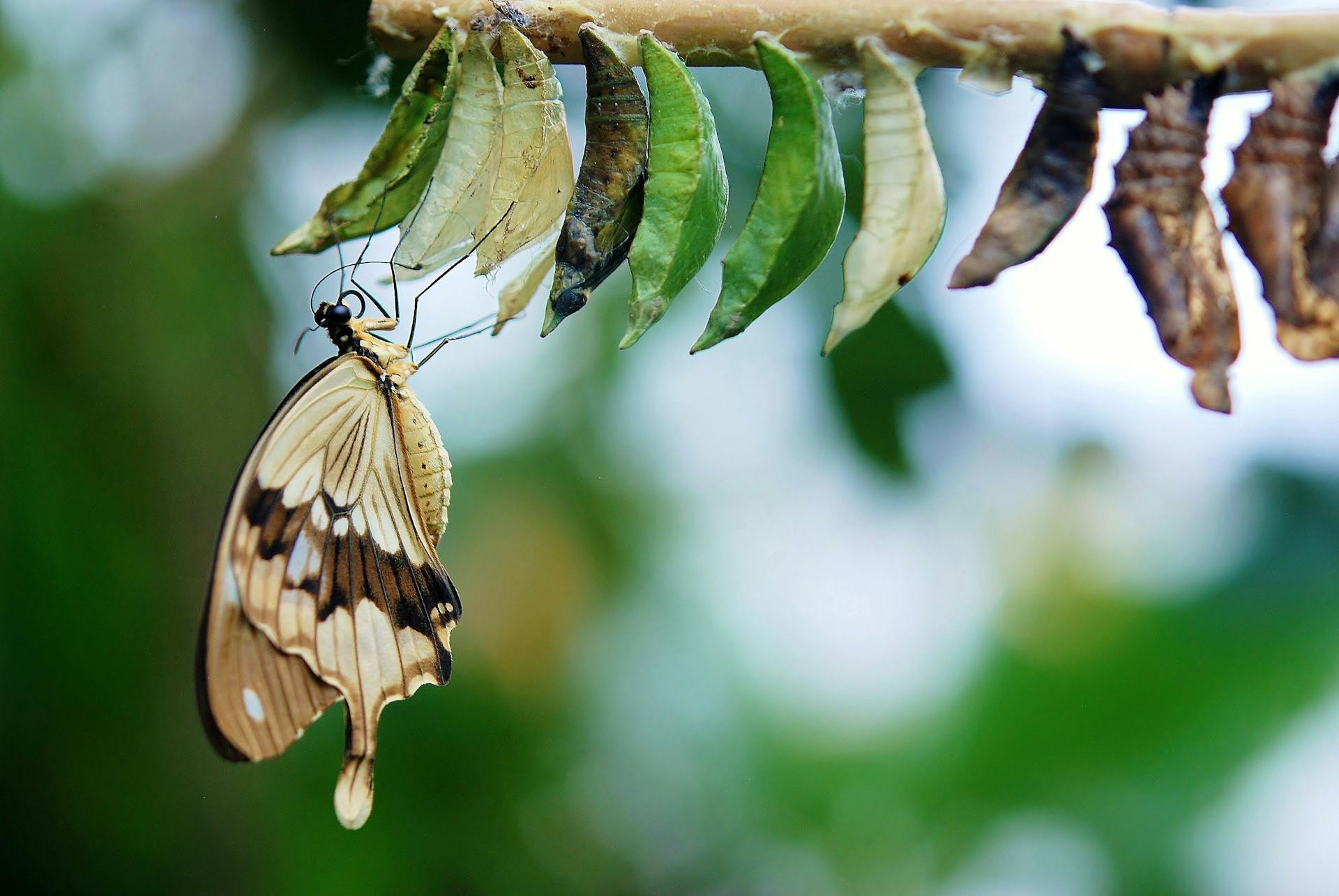
A caterpillar dissolves. Almost entirely. Inside the chrysalis, nearly every cell breaks down into biological soup. And yet, from that dissolution, a butterfly emerges that somehow remembers things the caterpillar learned. Scientists have shown this. The old form is gone. But it was not rejected. It was included and transcended.
A teenager doesn’t simply stop being a child. The child lives inside the adult. The best adults are the ones who kept access to the child’s wonder, curiosity, and rawness. And added the capacity to hold responsibility, complexity, and consequence.
This is transclude. The fundamental pattern of all natural development.
Now let me tell you what I see in organizations.
I see two failures, and they are mirror images of each other.
The first failure is transcendence without inclusion.
These are the organizations that fall in love with freedom. I’ve worked with many of them. They read the books about self-organization. They attend the conferences about flat hierarchy. They become enchanted by the idea of emergence, flow, organic growth. They want to be alive.
And so they throw away structure. They dismantle hierarchy. They reject processes, roles, boundaries. They leap upward, reaching for something beautiful, without including the foundations that hold things together.
What happens? They stretch tall with no spine. For a while, the energy is intoxicating. The freedom is real. People feel unleashed. And then, slowly or suddenly, the whole thing collapses inward. Decisions don’t get made. Conflicts don’t get resolved. The strongest personalities take over, not through formal power, but through informal dominance. Which is often worse.
You’ve seen this. I know you have. The organization that wanted to be free and ended up being chaotic. That wanted to transcend the old. And simply lost it.
The second failure is inclusion without transcendence.
These are the organizations that know exactly what they are. They have clear processes. Clear roles. Clear expectations. Everything runs smoothly. Compliance is high. Safety is high.
But nothing moves.
They hold onto what they’ve built with such force that they cannot outgrow it. Every attempt at change is absorbed, neutralized, translated back into the existing framework. New ideas arrive and are quietly smothered by the weight of “how we do things here.”
These organizations are stable the way a fossil is stable. Perfectly preserved. Ice cold. And perfectly dead…
The organizations that actually thrive do something different. Something harder.
They include. They honor what was built. The systems, the knowledge, the relationships, the pain that went into creating what exists. They don’t mock the old. They don’t dismiss it. They hold it.
And then they transcend. Not by destroying, but by outgrowing. The old shell cracks. Not because it was wrong, but because it was outgrown. What emerges is larger, more complex, more alive. And it carries the old inside it.
This is the holon principle or a principle of holons. Every whole is simultaneously a part. Every level of development includes the ones below it and adds something new. Atoms become molecules become cells become organisms. Not by replacement. By transcluding.
I think this is one of the most useful lens I know for understanding why organizational change fails and how it can succeed.
The real question is always: what do we carry forward, and what do we outgrow?
Transclude. One word. The whole secret hidden in plain sight.
Szabolcs Emich is Chief Innovation Officer at Atlas Platform and founder of Jövőképző, working at the intersection of organizational development, anthroposophical thinking, and technology.